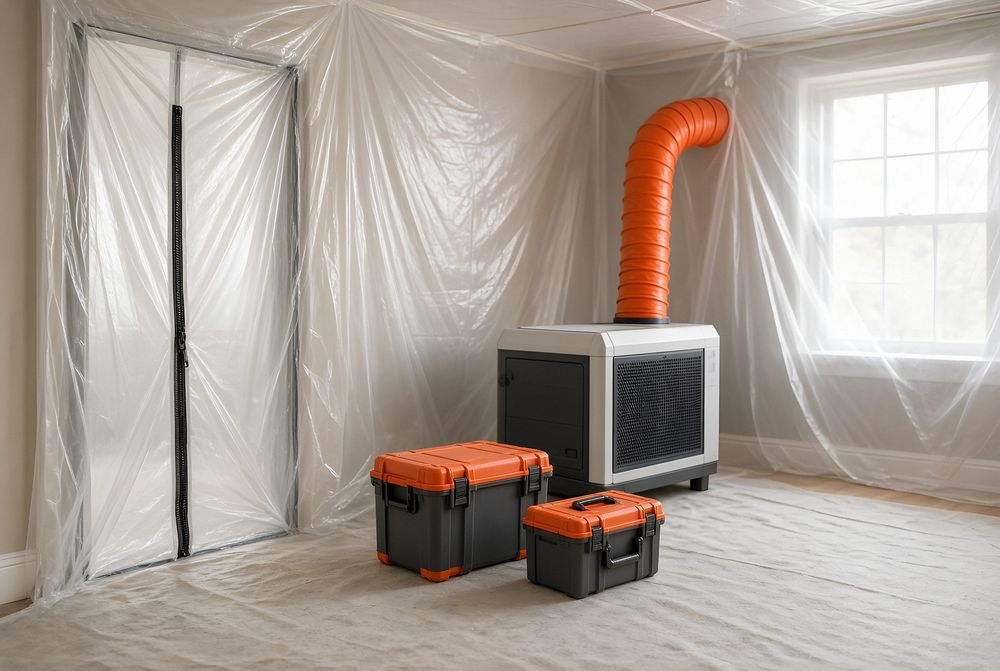
When contamination goes deeper than the floor covering
Liquids don't stop at carpet or flooring. Blood, decomposition fluid, pet urine and sewage soak through pads and seams into plywood or OSB subfloor, run along joists, and settle into concrete pores. Once there, they cause odor, staining that bleeds through new finishes, and continuing biological contamination. New flooring installed over a contaminated subfloor nearly always fails, either with an odor or with stains that come back.
Structural decontamination means opening the floor, finding the full extent of the contamination and dealing with it at the structure.
Where it's commonly needed
- After unattended deaths and decomposition
- Under large blood events where carpet was saturated
- In homes with long-term pet or animal-hoarding urine
- Manufactured homes with particleboard subfloors and belly wrap
- After sewage backups that reached wood floor systems or crawlspaces
Our process
- Expose. Flooring and pad are removed to reveal the subfloor, and staining and moisture are mapped.
- Decide: clean, seal or replace. Lightly affected solid wood can often be cleaned and sealed. Saturated plywood, OSB or particleboard is usually cut out and replaced. Joists are cleaned, and sanded where needed, then treated.
- Controlled cutting. Affected subfloor sections are removed back to clean material, keeping as much sound structure as possible.
- Clean and disinfect exposed framing and concrete with enzymatic and detergent products, then disinfect.
- Concrete. Slabs are cleaned, and an encapsulant suited to concrete may be applied before new flooring.
- Seal. Cleaned wood is coated with an odor- and stain-blocking encapsulant.
- Document with photographs of the exposed structure, the work done and the final condition, so the rebuild contractor and insurer can see what's under the new floor.
Manufactured homes
Manufactured homes often use particleboard decking and have ductwork running under the floor inside a belly wrap. Contamination can reach both. Particleboard that has absorbed fluids usually has to be replaced, and duct sections may need to be cleaned or replaced as well.
Common questions
Can't we just put new carpet down over it?
That almost always brings the odor back. The source has to be removed or sealed first.
Who replaces the subfloor afterward?
Replacing subfloor is carpentry. We leave a clean, documented structure, and your contractor rebuilds from there. We can coordinate the handoff.