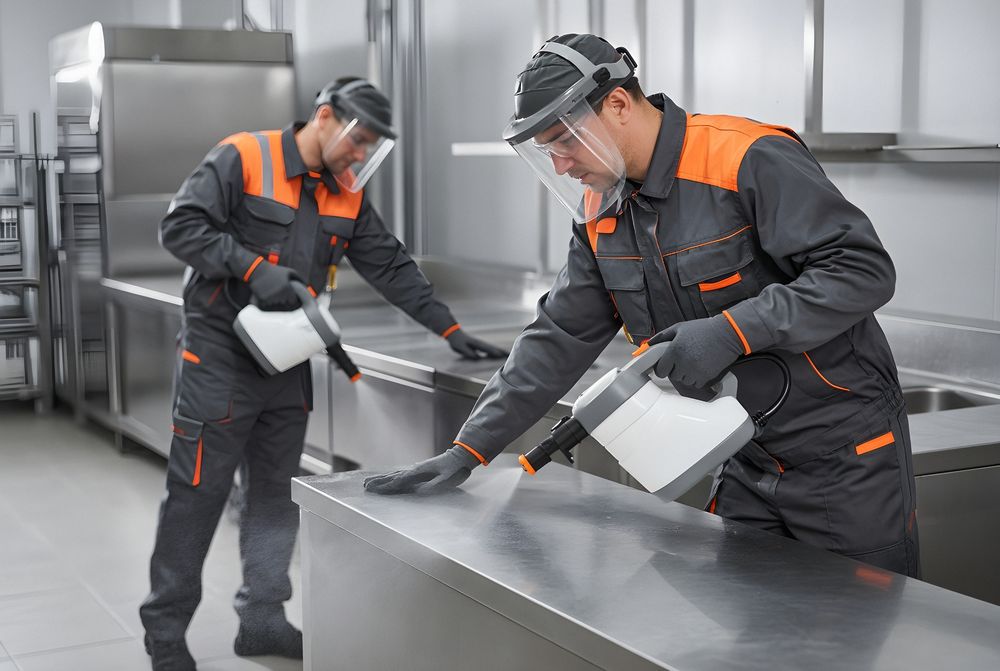
Disinfection done properly
Disinfection is easy to promise and harder to do well. A product only does what its label claims when the surface has been cleaned first, the product is right for the organism of concern, it is applied at the correct dilution, and the surface stays wet for the full contact time on the label. Most disinfection failures come from skipping one of those steps.
Professional disinfection is a documented process. It is not a spray-and-go service.
Clean, then disinfect
The CDC and EPA both describe cleaning as a separate step from disinfecting. Cleaning removes soil and organic matter that can shield organisms and inactivate some disinfectants. Disinfecting then kills the organisms named on the product label. Our procedures always do both, in that order.
Choosing the right product
We select EPA-registered disinfectants whose labels list the organisms of concern. For example, C. difficile spores call for products specifically registered against them, and norovirus calls for products with norovirus claims. EPA maintains searchable lists of registered products by pathogen. We also consider surface compatibility, occupant sensitivities and the re-entry interval on the label.
Application methods
- Manual application. Wiping and scrubbing high-touch and soiled surfaces remains the most reliable method for most work.
- Electrostatic spraying. Charged droplets wrap around complex surfaces for more even coverage. It works best on surfaces that have already been cleaned and when used with a product labeled for electrostatic application.
- Fogging and misting. Useful in some situations, but used only with products whose labels allow it and only in unoccupied spaces. Fogging doesn't replace cleaning.
- Soft-surface and upholstery treatment. Uses products and methods labeled for porous surfaces where they exist. Otherwise items may need to be laundered, removed or replaced.
Where it's used
- After illness in a home, such as norovirus, MRSA or C. diff
- Outbreak response in schools, offices, gyms, senior living and other facilities
- Whole-home or whole-suite disinfection after a biohazard cleanup
- HVAC and duct decontamination where it is part of the contamination pathway
- Scheduled preventive programs for higher-risk facilities
Verification
Visual inspection is not proof of cleanliness. ATP testing measures residual organic matter and is a useful check on cleaning quality, though it doesn't identify specific pathogens. Where a project calls for organism-specific confirmation, environmental sampling can be coordinated through a qualified lab. Our ATP testing guide explains the strengths and limits of each approach.
What we don't claim
No disinfection service can guarantee a space is free of every pathogen, or that no one will become ill afterward. We don't make health claims beyond what product labels and the published science support.