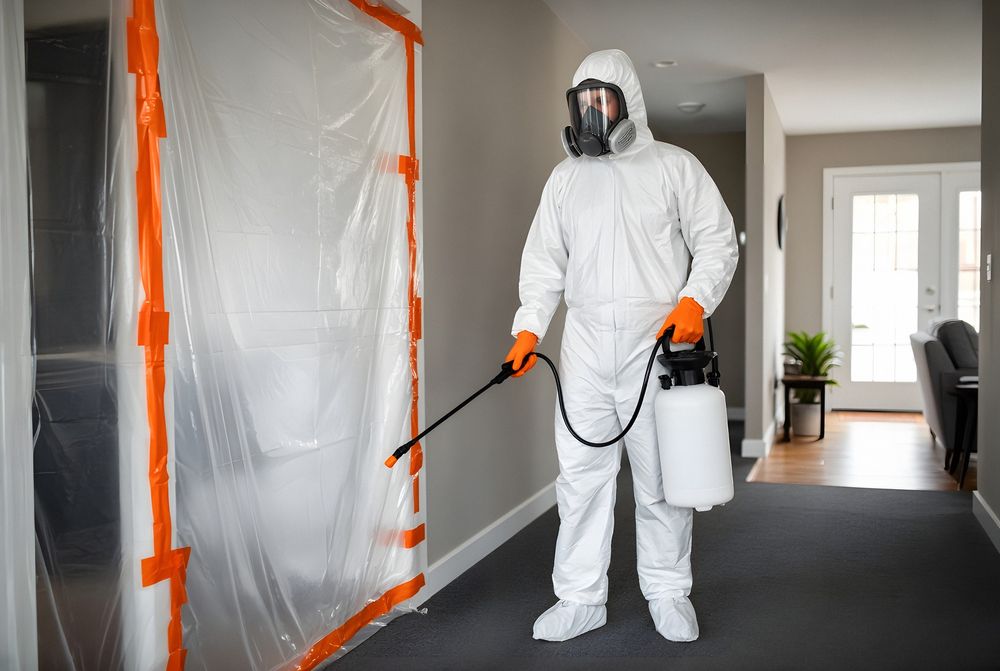
Blood rarely stays where it lands. Liquids follow gravity, capillary action and gaps in construction, so the visible stain on a carpet or floor is often the smallest part of the contamination. Understanding how blood moves through building materials explains why remediation scopes include things you can't see, and why surface cleaning alone often fails.
Why liquids spread
Three forces drive spread:
- Gravity pulls liquids down through layers: carpet to pad, pad to subfloor, subfloor to the joists and the ceiling below.
- Capillary action draws liquids along fibers and through tiny spaces, the same way a paper towel soaks up water. Carpet fibers, pad foam, drywall paper and wood grain all wick fluid outward.
- Gaps and seams in construction, such as between floorboards, under baseboards, around outlets and along tack strips, act as channels.
The volume of fluid, the time before cleanup, and the materials involved determine how far it goes.
Carpet and pad
Carpet is the most common surface affected in homes. Blood soaks through the carpet fibers into the backing and then into the pad, which is highly absorbent. The pad spreads fluid outward under the carpet, often well beyond the visible stain on top. When fluid reaches the tack strip along walls, it can travel into the base of the wall.
What looks like a stain the size of a dinner plate on the carpet surface can be a stain several times larger in the pad. That is why professionals pull back carpet and inspect the pad and subfloor before deciding what to remove.
Hardwood and laminate
Finished hardwood resists liquids on its surface, but fluids find the seams between boards and run underneath. Once under the boards, they reach the subfloor and the underside of the wood, where cleaning can't reach. Laminate and engineered flooring behave similarly, and their fiberboard cores swell when wet.
Vinyl plank and sheet flooring have seams and edges where fluids can get underneath. Glue-down floors may trap fluids in the adhesive layer.
Tile and grout
Glazed tile is non-porous and cleans well. Grout is porous and can absorb fluids. Cracked tiles or grout lines may let fluid reach the underlayment. Depending on the extent, grout may need cleaning, sealing or replacement.
Subfloor and joists
Plywood and oriented strand board (OSB) subfloors absorb fluids readily. Saturation can delaminate the layers. If enough fluid accumulates, it can reach the floor joists below and drip into the ceiling of the room or basement underneath. On upper floors of apartment buildings, this can mean contamination in a neighbor's ceiling.
Concrete
Concrete is porous. Blood can soak into the surface and leave stains after cleaning. Concrete is durable, though, and can usually be cleaned, treated and sealed rather than removed. Cracks and expansion joints can hold fluids.
Walls and drywall
Splatter and spray reach walls, and the paper face of drywall absorbs fluids. Fluids on the floor can also wick up into the base of drywall and baseboards. Gaps around electrical outlets, switches and baseboards can let fluids into wall cavities, where insulation absorbs them.
Furniture and soft goods
Mattresses, box springs, upholstered furniture and cushions absorb large amounts of fluid into foam and padding. The underside of a mattress or the frame of a sofa may be contaminated even when the top looks only lightly stained.
HVAC systems
Floor registers and return grilles near the contamination can collect fluids and draw odor into ductwork. If fluids entered a floor duct, the duct may need cleaning or replacement.
Time makes it worse
The longer blood sits, the deeper it penetrates and the more it spreads through capillary action. It also dries and bonds to surfaces, and biological breakdown begins, producing odor. Prompt professional response limits the damage.
How professionals trace contamination
Technicians use several methods to find the full extent:
- Visual inspection under bright light, including behind and under furniture
- Pulling back carpet to inspect the pad, tack strip and subfloor
- Removing baseboards to check the base of walls
- Moisture meters to detect wet areas in subfloors and walls
- Inspection openings, small cuts in drywall to check cavities
- Checking below, including the ceiling of the room underneath
- Odor tracing, since odor often points to hidden sources
Why this matters for your estimate
Remediation estimates include removal of materials beyond the visible stain because of these spread patterns. A good company will show you, with photos, how far contamination reached, and will remove contamination plus a reasonable margin. If an estimate seems large for a "small stain," ask to see what the inspection found.
Why you shouldn't just clean the surface
Cleaning the top of a carpet or wiping a floor removes what's visible, but contamination in the pad, subfloor and walls remains. It continues to support bacteria and odor, and stains can wick back to the surface. Repeated cleaning may push fluid deeper. Proper remediation removes what's contaminated, then cleans and disinfects what remains.
Key takeaways
Blood spreads down, outward and along seams through carpet pad, under hardwood, into subfloors, up drywall and into wall cavities. Visible stains understate the problem. Professionals trace the full extent with inspection and tools, remove contaminated materials with a margin, and clean and disinfect what's left.
Sources
- OSHA: 29 CFR 1910.1030, Bloodborne Pathogens Standard
- OSHA: Bloodborne Pathogens and Needlestick Prevention
- IICRC: ANSI/IICRC S500 Standard for Professional Water Damage Restoration
This guide is general information. It is not legal, medical, environmental or safety advice. Rules vary by state and locality. For a specific situation, consult the relevant agency or a qualified professional.