People often ask what "level" of biohazard a scene is. The question usually comes from the laboratory biosafety levels, BSL-1 through BSL-4, that appear in news stories and movies. Those levels are real, but they describe something different from what happens in a home or business. This guide explains biosafety levels and how property hazards are actually assessed.
Where biosafety levels come from
Biosafety levels are defined in Biosafety in Microbiological and Biomedical Laboratories (BMBL), published by the CDC and NIH. The BMBL is an advisory document that recommends practices, safety equipment and facility design for laboratories that work with infectious agents on purpose. It emphasizes risk assessment based on the specific agent and procedure.
The four levels, in brief:
- BSL-1: work with well-characterized agents not known to consistently cause disease in healthy adults. Standard microbiological practices; work on open benches.
- BSL-2: work with agents of moderate hazard that can cause human disease, such as many common bacteria and viruses. Adds limited access, biohazard signage, protective equipment, and biological safety cabinets for procedures that create aerosols.
- BSL-3: work with agents that can cause serious or potentially lethal disease through inhalation. Adds controlled access, directional airflow, respiratory protection and more.
- BSL-4: work with dangerous and exotic agents that pose a high risk of life-threatening disease and have no available treatments or vaccines. Requires full-body, air-supplied suits or cabinet systems in specialized, isolated facilities.
Why these levels don't apply to cleanup scenes
Biosafety levels assume a known organism, handled intentionally, in a designed facility. A crime scene, an unattended death or a sewage backup is different in every respect: the organisms present are unknown and mixed, the contamination is spread through ordinary building materials, and the goal is removal rather than controlled experimentation. Labeling a home as "level 2" or "level 3" isn't meaningful under the BMBL.
How property hazards are really assessed
Professionals size up a cleanup by looking at practical factors:
What the material is. Blood and bodily fluids call for bloodborne pathogen precautions under OSHA's standard. Rodent droppings call for wet methods because hantavirus risk is through inhaling dust. Old bird and bat droppings call for dust control and respiratory protection because of Histoplasma. Raccoon latrines require physical removal and heat because roundworm eggs resist chemicals. Sewage is treated as grossly contaminated water. Drug residue is a chemical hazard with its own methods.
How much there is and where it went. Volume and spread determine how much material must be removed and how long work takes.
How long it has been there. Older contamination is deeper, more established and more odorous.
The surfaces involved. Porous materials often must be removed; non-porous ones can usually be cleaned.
Other hazards present. Sharps, drug residue, structural damage, electrical hazards, mold and pests change the protective equipment and procedures.
Who uses the space. Homes with children or vulnerable people, food areas and healthcare spaces call for extra care.
How this translates into protection
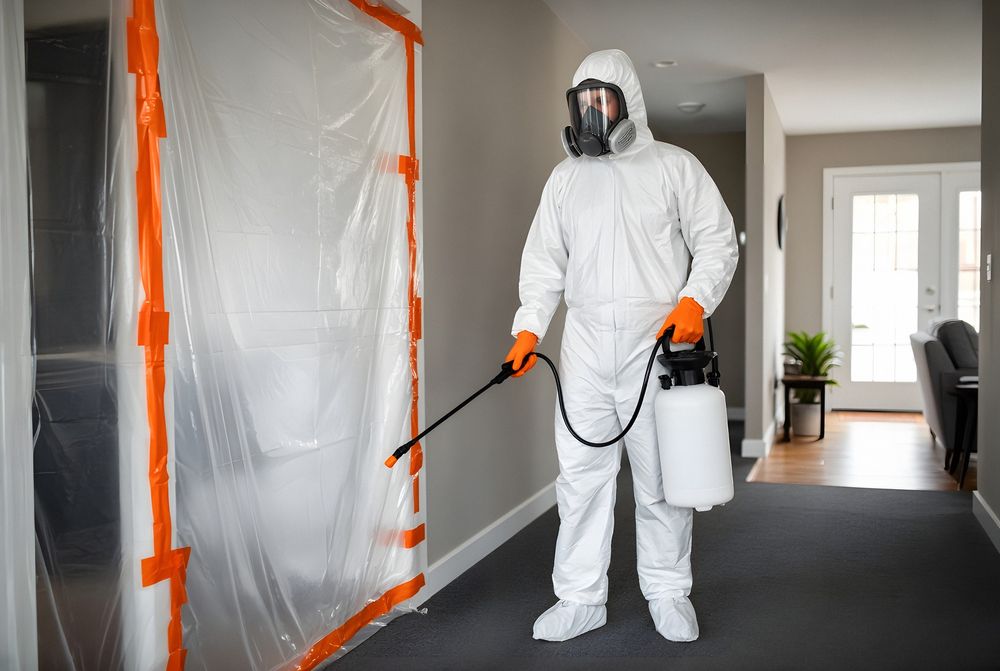
Based on those factors, crews choose protective equipment and methods. A small blood cleanup might call for gloves, eye protection and disposable coveralls. Decomposition work typically adds respiratory protection and containment. Heavy rodent infestation in an enclosed space calls for respirators and wet methods. Fentanyl or other potent drug residue may require higher levels of respiratory and skin protection, following guidance developed for emergency responders.
A worked example
Consider two jobs. In the first, a person was injured in a kitchen and lost a moderate amount of blood onto tile and a cabinet face, and the scene was released the same day. The hazard is bloodborne pathogens on mostly non-porous surfaces; crews wear gloves, eye protection and coveralls, clean and disinfect, and replace a grout section. In the second, a person died in a carpeted bedroom and wasn't found for two weeks in summer. The hazards include decomposition fluids in carpet, pad and subfloor, heavy odor, insects and possibly the HVAC return; crews add respiratory protection, containment and air filtration, remove materials down to the joists, and treat the air system. Neither job has a biosafety level, but the second clearly needs more protection and more work.
Industry descriptions you may hear
Some companies describe jobs as "light," "moderate" or "heavy," or use their own numbered scales, especially for hoarding. These are internal descriptions, not regulatory categories. They can still be useful for communicating scope, as long as the estimate explains what is actually included.
Questions to ask
Instead of asking what level a job is, ask:
- What hazards did you identify?
- What protective equipment will your crew use, and why?
- What will be removed, and how will you contain the work?
- How will waste be handled?
- How will you verify the result?
Key takeaways
Biosafety levels 1 through 4 describe how laboratories handle known infectious agents. They are not a rating system for homes or businesses. Property cleanup is assessed by the type of material, the amount and spread, the time elapsed, the surfaces involved and other hazards present, and protection and methods are chosen to match.
Sources
- CDC/NIH: Biosafety in Microbiological and Biomedical Laboratories (BMBL), 6th Edition
- OSHA: 29 CFR 1910.1030, Bloodborne Pathogens Standard
- CDC: How to Clean Up After Rodents
- CDC/NIOSH: Histoplasmosis and Work
- CDC: Preventing Raccoon Roundworm
- CDC/NIOSH: Fentanyl, Emergency Responders at Risk
This guide is general information. It is not legal, medical, environmental or safety advice. Rules vary by state and locality. For a specific situation, consult the relevant agency or a qualified professional.